
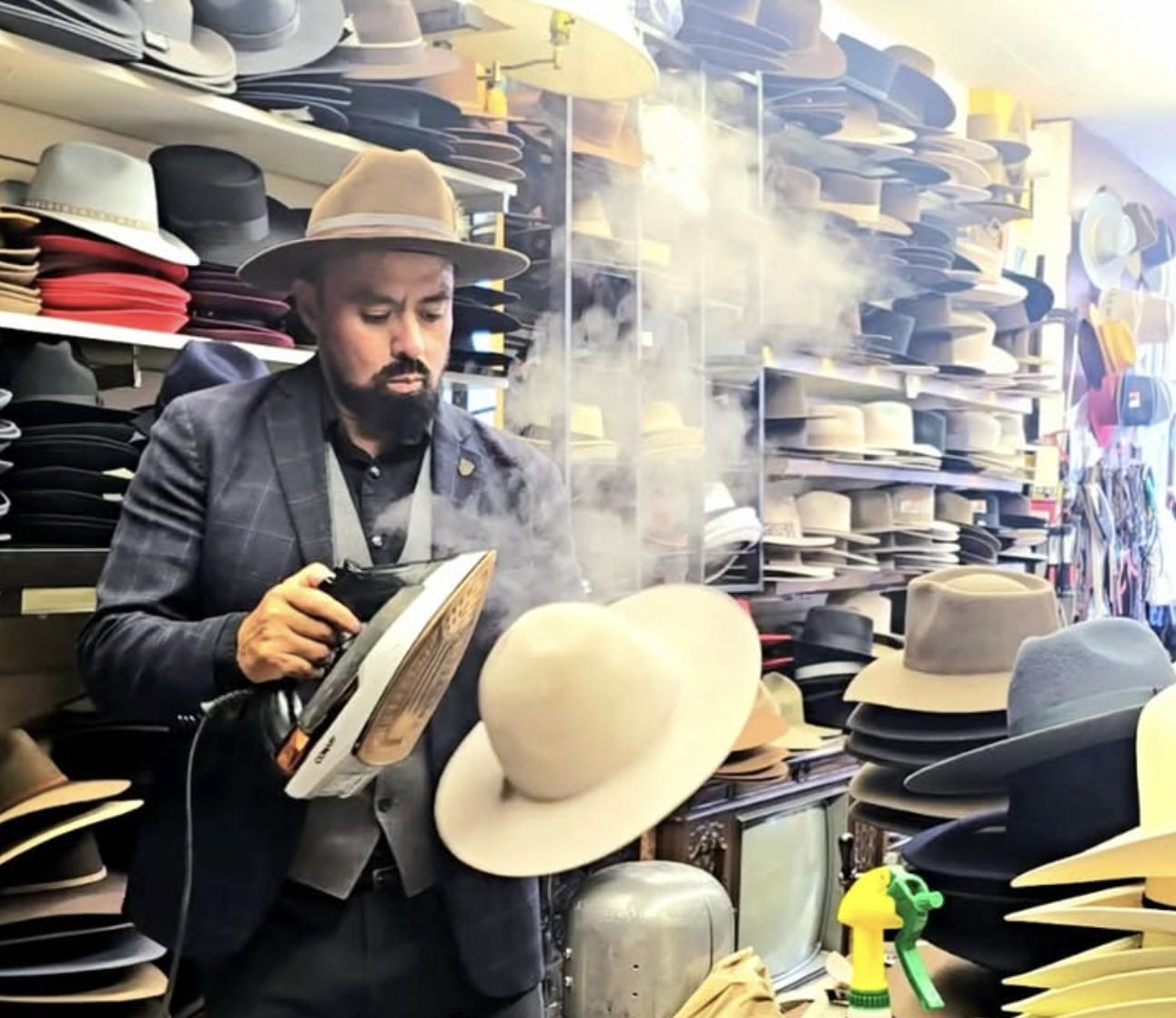
Inside one of Kensington Market's oldest hat shops is a familiar neighbourhood face who has spent the last 19 years, one could say wearing many different hats, after spending nearly two decades operating one storefront or another along the stretch of Augusta Avenue.
In the midst of the summer crowds of tourists that explore Kensington Market, the summer heat drifts into Sombrero by Altto's rustic charms at 261 Augusta Avenue. Run by Totto Alvarado, the shop stands in front of shelves upon shelves lined with bowler hats, cowboy hats, and some brimmed with intricate detailing while others present as the traditional brown and black suede cowboy hats, in a space not much wider than a hallway.

When you ask Alvarado why he landed on hats as his primary merchandising specialty after having owned multiple fashion boutiques across the city, he explains that there is much more to hats as a tool for fashion and expression than one may initially believe.
"There is no bestseller. A hat is very difficult to go for one specific style. It has to do with your face shape, the way that you dress, what you need it for."
The brand crafts and curates handcrafted, traditional hats, wool styles like the El Sevillano, and unique accessories, alongside bohemian-style headwear such as wool and open-crown hats.
If you ask Alvarado where he's from, the answer spans a few continents. Born in Florence, Italy, his family would eventually relocate to Guadalajara, Mexico and then Puerto Vallarta in his teenage years. Alvarado came to Canada to study at the University of Toronto at the age of seventeen, and found himself in need of more income than a minimum wage student job could provide him.
Walking through Kensington Market, a neighbourhood he often frequented, Alvarado found himself struck with a burst of inspiration to approach a local shop owner named Mike, who was located at 237 Augusta Avenue.
"I spoke to a Jewish man down the street, 237 Augusta, and I asked him to allow me to sell things in the front, which actually began as just t-shirts," Alvarado said.
Alvarado taught himself to screen-print t-shirts and began spending his weekends hustling as a university student selling shirts with "silly sayings," logos, and often, by his own description, "stupid things" that would catch the attention of any passersby he could attract. After about a month of mastering screen-printing t-shirts, he added a table of sunglasses to his mini storefront pop-up. Although Alvarado had no formal support system when he began selling, he came from a heavily business-minded family in Italy, and even joked that his instilled confidence came from watching the "Italian old men" in his family working in business and approaching people for sales.
A few months after he first started selling out front, Alvarado opened his own storefront at 261 Augusta Avenue. By 2006, that storefront had been transformed into his very own fashion boutique. Mike, meanwhile, eventually retired from his own shop at 237 Augusta.
His boutique had expanded to two locations in Kensington Market and one on Queen Street. What began as a successful run of multiple store locations would quickly begin to decline as fast fashion overtook the market with its lower margin prices and its ability to churn out numerous products at a high scale volume that were often most convenient and accessible to local communities.
Over the next five years, Alvarado would watch as fast fashion corporations overtook many local sellers' ability to succeed against large conglomerates.
"Then came H&M, Old Navy, Marshalls, right nearby to us. China started also giving our designs, our printings, to these major companies. So H&M came out with the same print, different dress, but same print priced at 18 dollars, 20 dollars."
Alvarado said his dresses, sourced from materials in Japan and China, sold for 60 to 80 dollars, while large chain corporations sold them for a fraction of his price. Fighting their pricing and ability to manufacture new clothing collections felt "impossible" for Alvarado to compete against as a small-scale boutique. He would end up closing two of his fashion boutiques as the novelty of his dress designs had been outsourced to corporations, choosing to keep only the store at 261 Augusta Avenue, one block away from where his roots in fashion first began.
All he knew at the time was that hats faced much less competition in the Kensington Market neighbourhood, with only one other hat maker in the entire neighbourhood, and that's when he decided to embrace hats.
Kensington Market has seen a wave of gentrification since 2006, with rent pricing now running about 10,000 dollars a month before additional costs, Alvarado explained, something that has pushed shop owners to increase their prices in response. In comparison to his past years at Queen and Spadina, he found it to be a much more lucrative neighbourhood, drawing a clientele that could absorb higher markups than today's Kensington Market can.
"You can't really do low markups anymore. But you have to be conscious also of the people who come here, so you have to keep the prices lower than what you can do."
Alvarado runs his store with only two part-time employees, and the store has had to adapt to the neighbourhood's clientele, which is often dominated by tourists, university students and youth, but he has learned to embrace the times rather than try to change them.
His advice to other entrepreneurs is to take as much advantage as you can of digital marketing tools such as social media to bring attention to a business.
"We all have a lot of media, right? Facebook, Instagram, Twitter and all that. So definitely use all of that to your advantage. It works," he said.
Still, he feels his small-scale operation has established enough of a presence in the neighbourhood even without overly relying on social media.
Today, almost 90 per cent of his production is made in-house between the Kensington storefront and a Mississauga warehouse that handles the heavier lifting for heat-based processes and material drying. The store is displayed with hats of all designs: bowler hats, traditional hats, cowboy hats, and a hat for everyone's unique style, with hats being all the rage for summers among country-festival fans and Toronto's wannabe cowgirls and cowboys.
As many who have passed through the store sense, Alvarado knows and loves hats. He shared his hopes that the shop's western-style hats will eventually expand into Calgary, Alberta in the near future, with many Torontonians already styling them at the Calgary Stampede.
Alvarado explains that hats are the one thing fast fashion couldn't touch. One block down from where he first sold t-shirts off a folding table with Mike, Alvarado is still betting on that idea, just one cowboy hat at a time.


