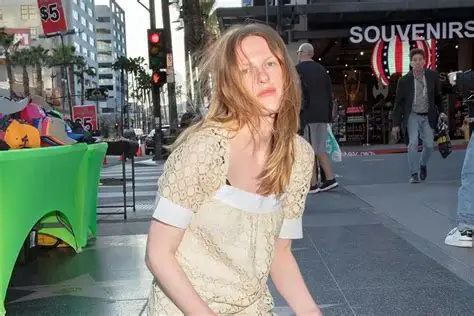
Hobert is unapologetic about embracing the odd and awkward aspects of growing up in her 20s. She writes from a place of understanding that adolescence spares no one. By adding a catchy jingle or talk-singy inner monologue over what is often self-pointedly observant or comedic in its own right, Hobert transforms the mundane into moments of catharsis.
When Gracie Abrams released her viral hit “That’s So True” last fall, many fans discovered Audrey Hobert through her collaboration on the track, which is celebrated for its unique musical style—a sneak peek into what fans would later stylistically Hobert’s forte.
Hobert’s debut album, Who’s The Clown?, was released on August 15th, 2025. The 12-track record uses classic pop production with diary-style lyrics to explore Hobert’s experience growing up. Rather than glamorizing her life to create a glittery-pop album, she confronts and often pokes fun at her own role in the chaos of adolescence, creating a playful yet introspective album.
On the opening track, “I like to touch people“, she sets the witty tone with a party scene where she jokes that she likes to “touch people”—not physically, as the title teases, but by making an impact and connecting with others, even if the connection is superficial or surface level.
Hobert’s positioning of the song as the opener is no coincidence. As a songwriter and self-proclaimed people-pleaser, she speaks candidly about the importance of allowing people the opportunity to see themselves reflected in a song, while also openly admitting her desire to feel validated by an audience.
The first single off the album, “Sue Me,” combines an upbeat pop melody with lyrics that maintain the facade of being fine when you’re really not. A universal feeling that likely contributes to the song having over 25 million streams on Spotify.
Hobert’s songwriting is a stylistic choice that becomes intertwined within each track. In songs such as “Wet Hair,” “Bowling Alley,” “Thirst Trap,” or” Don’t Go Back to His Ass,” we begin to understand that the stream of messy consciousness or “word vomit” is integral to Hobert as a songwriter.
Though she tries to play it cool, this track reveals how much she over-thinks her every move; it becomes a confession of Hobert’s psyche. She becomes performative in her effortlessness, revealing she cares — perhaps even too much.
Hobert self-consciously refers to herself as “crazy”—not out of instability but from a place of exhaustion from the social performance of taking photos, filtering them, and chasing attention. It’s a vicious cycle she doesn’t want to engage in, but also a performance that becomes intertwined with her self-worth.
At the track’s ending—”I once read some people’s beauty can’t be captured”—we begin to watch Hobert question the culture that subjugates women’s importance to their physical appearance.
A similar sentiment is expressed on the track “Chateau,” which critiques the shallow culture within celebrity circles and the feeling of being out of place amongst A-listers.
Hobert explores her personal insecurities further on tracks like “Sex and the City” and “Phoebe.” She cleverly weaves in recognizable pop-culture references and showcases a songwriting style that feels both referential and unmistakably her own.
“Sex and the City” is a slow, acoustic ballad that cleverly explores the tension between fantasy and modern dating, comparing Hobert’s life to Carrie Bradshaw’s illustrious life.
Hobert writes candidly about feeling her life is inferior to media depictions of dating with lines like: “If this were Sex and the City, I’d get in, and he would’ve already called me.”
The track reflects Hobert’s insecurities and those of many young people who find themselves comparing their love lives to fantasies, only to end up feeling inadequate about what pop culture insists is the universal experience of romance.
“Phoebe” is both a song about insecurities and an anthem of self-acceptance, moving from lines like “I think I’ve got a fucked up face that thought used to haunt me” to “Who cares if I’m pretty, I feel like I’m Phoebe.”
On “Phoebe,” it becomes clear that she finds the answer to the question that dictates much of the album’s anxieties around feeling desired or validated by men. The pivotal track sees Hobert confront the unfulfilling cycle of chasing societal validation, before coming to the revelation that beyond just her exterior appearance; her beauty lies in something more profound than aesthetics.
By the time the hyper-pop ballad of partying, “Silver Jubilee,” closes the album, one thing is clear: growing up is messy, but it should be celebrated. In Hobert’s own words as stated in an interview with Russh, “My greatest hope for this album…is that people feel inspired to be themselves, and that everywhere they go on this planet, they feel entirely comfortable in their own skin.”