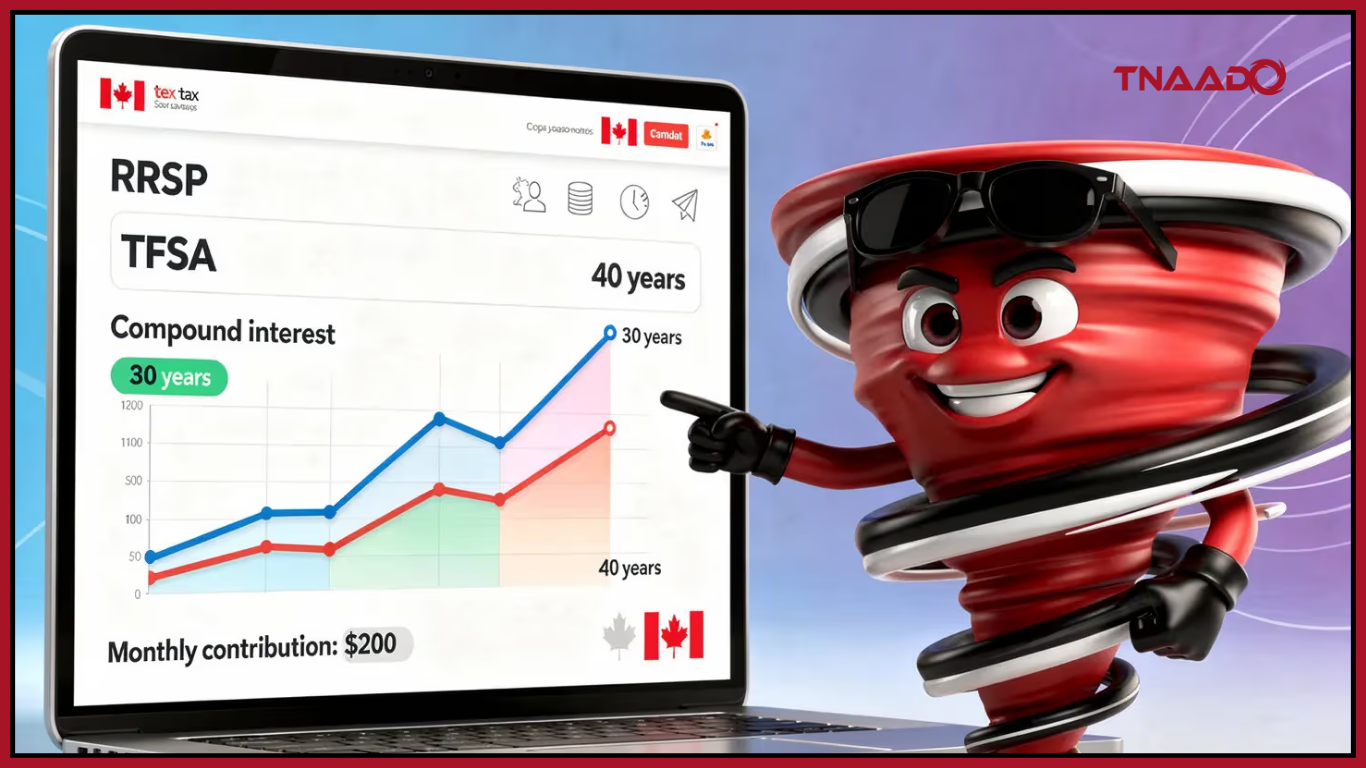
If you're 25 years old and investing $200 per month, you are sitting on one of the most powerful financial advantages in Canada: time.
Yet most young Canadians don't know how much their money can grow over 30–40 years, whether to prioritize an RRSP or a TFSA, what their 2025 contribution limits actually are, or how compound interest really works.
If you're searching for any of these, you're in the right place:
🔍 Common searches that led here:
RRSP calculator TFSA contribution room compound interest calculator CanadaThis guide walks you through the real math behind long-term investing and shows how to model different scenarios side by side using TNAADO's free calculator. No sign-up. No email. Built for Canadians.
The Power of $200/Month at Age 25
Let's start with a simple scenario: you're 25 years old, contributing $200/month at a 6% annual return over 30–40 years. The numbers are striking.
The extra 10 years nearly doubles your outcome again — without doubling contributions. That's the power of compound interest.
What Is Compound Interest (And Why Time Matters Most)
Compound interest means you earn returns on your original contributions — plus all previously earned returns. Over decades, growth becomes exponential. It's not linear. It accelerates.
Early vs. Late Investor: A Real Comparison
Person A Early Starter
- Invests from age 25 to 35 only
- Stops contributing after 10 years
- Leaves money invested until retirement
Person B Late Starter
- Starts investing at age 35
- Invests consistently until age 65
- 30 years of contributions
In many cases, Person A still ends up ahead — simply because of time in the market. The earlier you start, the more time compounds your growth.
"At 25, the most powerful financial asset you have is not your salary. It's time. Even $200 per month can turn into hundreds of thousands over 30–40 years."
TFSA Contribution Room 2025
The Tax-Free Savings Account (TFSA) is one of the most powerful investment vehicles in Canada. Here's what you need to know for 2025.
- Contributions are not tax-deductible
- Growth is completely tax-free
- Withdrawals are tax-free
- Withdrawn amounts re-added to room next year
- Ideal for young professionals
- Great for flexible investing
- Works as an emergency fund vehicle
- Strong for medium & long-term growth
RRSP Contribution Limit 2025
The Registered Retirement Savings Plan (RRSP) works differently — it's income-based and primarily designed for retirement savings with a tax-deferral benefit.
- If you earn $60,000 → room = $10,800
- Contributions are tax-deductible
- Growth is tax-deferred
- Withdrawals are taxable
- Higher income earners
- Reducing taxable income now
- Long-term retirement planning
- Reinvesting annual tax refunds
RRSP vs TFSA: What's the Difference?
| Feature | TFSA | RRSP |
|---|---|---|
| Tax on Contributions | No deduction | Tax-deductible ✓ |
| Tax on Growth | Tax-free ✓ | Tax-deferred |
| Tax on Withdrawal | Tax-free ✓ | Taxable |
| 2025 Contribution Limit | $7,000 / year | 18% of income |
| Best For | Flexibility | Tax reduction & retirement |
Side-by-Side Scenario: 25-Year-Old Investing $200/Month
Assumptions: age 25, retire at 65, 6% average annual return, 40-year investment period, $96,000 total contributions.
TFSA Outcome
RRSP Outcome
RRSP likely generated thousands in tax refunds during working years. If reinvested, total net outcome can exceed TFSA — depending on tax brackets. That's why modeling both matters.
Why Most Online RRSP Calculators Are Incomplete
Most Free Calculators
- Don't compare RRSP and TFSA side by side
- Ignore tax bracket assumptions
- Don't factor in reinvested refunds
- Use unrealistic return rates (10–12%)
- Don't show long-term compounding clearly
TNAADO Calculator
- Compares RRSP vs TFSA in one dashboard
- Uses realistic rate assumptions (5–8%)
- Models 30, 35, 40+ year scenarios
- Includes tax impact and refund modelling
- Designed for Canadian contribution rules
Common Mistakes Young Investors Make
Pro Tips for 25-Year-Old Investors
FAQ — RRSP Calculator & TFSA Contribution Room
Start Early. Let Time Do the Work.
At 25, the most powerful financial asset you have is not your salary — it's time. Even $200 per month, invested consistently, can turn into hundreds of thousands over 30–40 years.
But choosing between an RRSP and a TFSA — and understanding your real contribution room — requires proper modelling. Don't guess. Run your numbers.
- RRSP Calculator with tax deduction modelling
- TFSA Contribution Room Estimator
- Compound Interest Calculator built for Canadians
- Side-by-side scenario comparison dashboard
- Free. No sign-up. No email. No account.
Compare RRSP vs TFSA — Side by Side.
Use the TNAADO free investment calculator to model compound growth, compare accounts, and plan your retirement with real Canadian contribution rules.