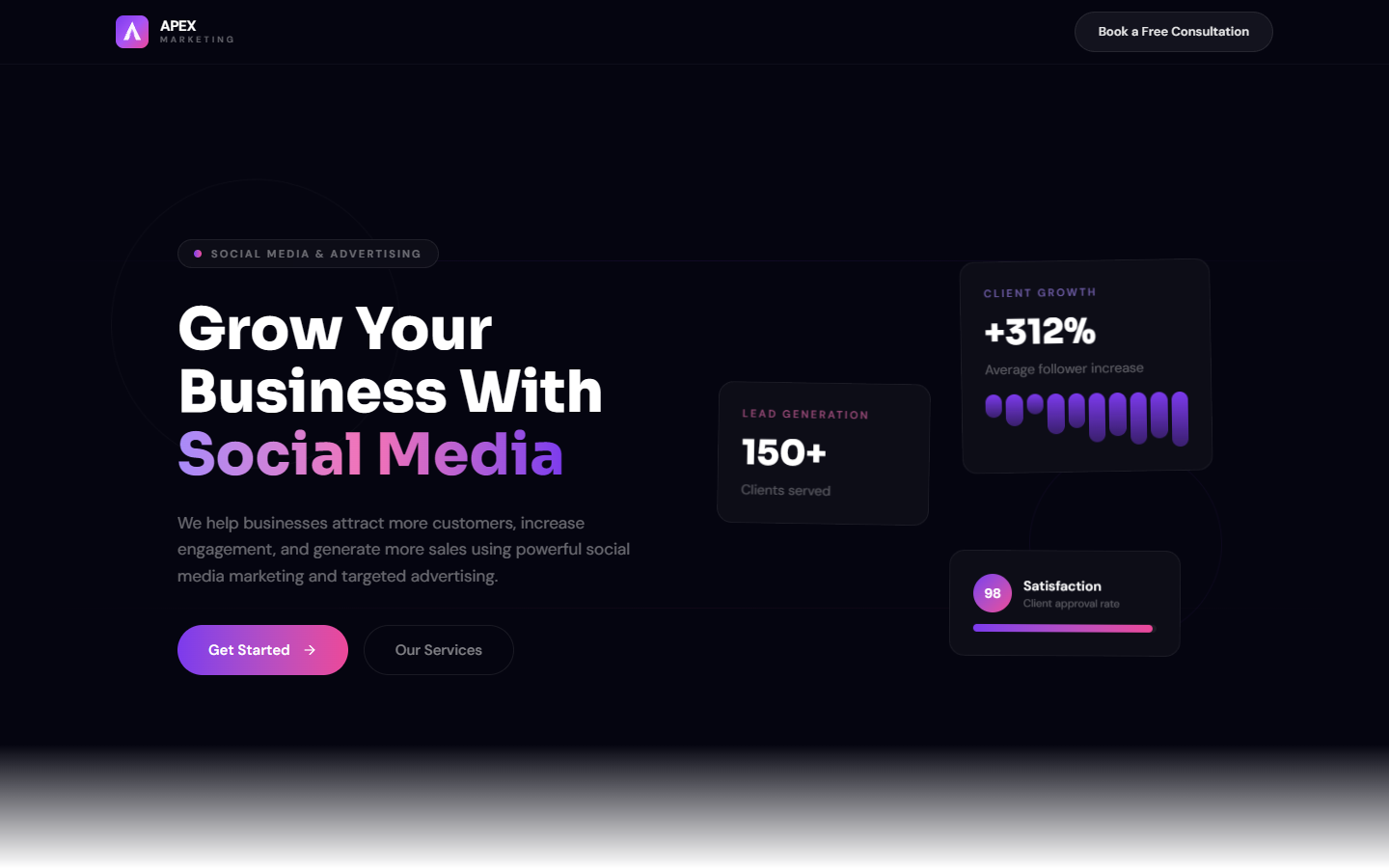
There is a particular irony in being a marketing agency without a website. You are asking prospective clients to trust you with their brand while your own brand lives nowhere but a phone screen and a business card. For Abdi Nasser, founder of Apex Marketing, closing that credibility gap was not just a nice-to-have—it was the single biggest barrier standing between his agency and its first wave of clients.
This is the story of how Apex Marketing went from zero online presence to a professional, conversion-focused website that started generating real inquiries on the same day it launched.
The Credibility Gap: Why Marketing Agencies Need a Strong Website More Than Anyone
Every business benefits from a professional web presence. But for a social media agency or advertising firm, the stakes are uniquely high. Your website is not just a brochure—it is your first portfolio piece. If a potential client visits your site and finds something generic, slow, or forgettable, you have already lost the pitch before it started.
This is what researchers call the credibility gap: the distance between what you claim you can do for clients and what your own online presence demonstrates. Studies consistently show that 75% of users judge a company's credibility based on its website design. For an agency selling marketing services, that number is effectively 100%.
Abdi understood this. Apex Marketing had the talent, the strategy knowledge, and the client relationships to succeed. What it lacked was a home base—a marketing agency website design that would instantly communicate competence, professionalism, and trustworthiness to anyone who landed on it.
What Actually Makes a Great Agency Website
Before diving into what was built, it is worth understanding what separates an effective small business website from one that just takes up space on the internet. Whether you are a social media agency, a consulting firm, or a local service provider, the principles are the same.
- Clarity over cleverness. Visitors should understand exactly what you do and who you serve within five seconds of landing on your page. Fancy animations mean nothing if your message is buried.
- Trust signals everywhere. Testimonials, client logos, case study snippets, awards—anything that lets a stranger think "other people have trusted this company, and it worked out." These are not optional. They are the backbone of building credibility online.
- One clear next step. The best lead generation landing pages do not offer twelve different paths. They guide visitors toward a single action: get in touch, book a call, request a quote.
- Mobile-first design. Over 60% of web traffic now comes from mobile devices. If your site is not built for phones first and desktops second, you are designing for the minority of your audience.
- Speed. Every additional second of load time costs you roughly 7% of conversions. A slow website is functionally a broken website.
These are not aspirational goals. They are baseline requirements for any website that converts visitors into leads in 2026.
The Process: Four Steps, One Day
The Approach: Building for Conversion, Not Just Aesthetics
When Abdi partnered with TNAADO to build the Apex Marketing site, the brief was straightforward: create a professional web presence that could start capturing leads immediately. Not next month. Not after a six-week discovery phase. Today.
That constraint shaped every decision. Instead of building a sprawling multi-page site that would take weeks to fill with content, the team focused on a single, high-impact landing page—a conversion-focused website designed to do one thing exceptionally well: turn visitors into inquiries.
This is a strategy worth considering for any new business. A well-built lead generation landing page will outperform a mediocre five-page website every time. You do not need a blog, an about page, a team page, and a resources section on day one. You need one page that clearly communicates your value and makes it dead simple to get in touch.
The approach followed a proven framework:
- Define the single conversion goal before touching any design work. For Apex, that was form submissions from potential clients.
- Write the copy first, then design around it. Too many websites start with a pretty template and then try to cram their message into it. The best results come from letting the message dictate the layout.
- Eliminate friction. Every element on the page either moves the visitor closer to the conversion goal or gets removed. No distractions, no dead-end links, no unnecessary complexity.
"Your website does not need to do everything. It needs to do one thing so well that visitors cannot help but take action."
Key Features of the Apex Marketing Site
The finished site at apexmarketing.black is a study in purposeful restraint. Every section earns its place by contributing to the conversion goal. Here is what made it effective:
A Headline That Speaks to the Client, Not the Agency
The hero section leads with a clear value proposition focused on what Apex Marketing does for its clients, not a list of services. Visitors immediately understand the outcome they can expect, which is far more compelling than a generic "welcome to our agency" message.
Services Showcase With Strategic Depth
Rather than listing services as bullet points, each offering is presented with enough context for a prospective client to understand the scope and think "yes, that is exactly what I need." This bridges the gap between awareness and consideration—the visitor does not need to schedule a call just to understand what is on offer.
Lead Capture That Respects the Visitor
The contact form asks only for essential information—no fifteen-field forms that feel like a tax return. Research shows that reducing form fields from four to three can increase conversions by nearly 50%. The Apex form hits that sweet spot: enough data to qualify a lead, not so much that visitors abandon the page.
Social Proof and Trust Signals
The site incorporates elements that build credibility online without feeling forced. This includes clear brand positioning, professional design consistency, and messaging that demonstrates industry knowledge. For a new agency, these signals compensate for the lack of a long track record by showing that the team understands its craft.
Mobile-First, Performance-Focused Design
The site was designed for phones first. Every element was tested on mobile screens before desktop, ensuring that the majority of visitors—who are likely discovering Apex through social media on their phones—get a flawless experience. Load times were kept well under two seconds, which is critical given that 53% of mobile users abandon sites that take longer than three seconds to load.
Results: From Launch Day to Lead Flow
The site went live the same day the project started. That fact alone is worth pausing on. In an industry where website projects routinely stretch into months of revisions, scope creep, and missed deadlines, Apex Marketing had a fully functional, conversion-focused website generating inquiries within hours of the initial conversation.
The immediate results told a clear story:
- Lead capture forms began receiving submissions on day one. The site was not a placeholder—it was actively working as a business development tool from the moment it went live.
- Abdi had a credible home base to share with prospects. Instead of describing his services verbally or sending a PDF, he could point anyone to a polished, professional URL that did the selling for him.
- The brand perception shifted immediately. A professional web presence transformed Apex Marketing from "a guy who does social media" to "a legitimate agency I should take seriously."
This is the power of a well-executed marketing agency website design. It does not just look good—it works as a 24/7 sales representative, qualifying leads and building trust while you focus on serving existing clients.
"A website is not an expense. It is your most patient salesperson—one that works every hour of every day and never forgets the pitch."
Practical Takeaways for Your Business
Whether you are launching a social media agency, a consulting practice, or any service-based business, here are the lessons from the Apex Marketing project that you can apply today:
- Start with one great page, not five mediocre ones. A single lead generation landing page with a clear message and a strong call-to-action will generate more business than a multi-page site filled with placeholder content.
- Design for your audience's device. If your clients find you through social media or search, they are almost certainly on mobile. A mobile-first design is not a feature—it is a requirement.
- Invest in trust signals early. Even without a long client roster, you can build credibility online through professional design, clear messaging, and demonstrated expertise in your content.
- Prioritize speed—both page speed and project speed. A fast-loading site improves conversions. A fast project timeline means you start generating returns sooner. Both matter.
- Make the call-to-action obvious and easy. If a visitor has to search for how to contact you, your conversion-focused website is not actually focused on conversion.
- Your website should prove your competence, not just claim it. For a marketing agency, this means the site itself must be excellent. For any business, it means the quality of your web presence should match the quality of your service.
Ready to Build a Website That Actually Works for Your Business?
The difference between a website that sits there and a website that converts comes down to strategy, focus, and execution. Apex Marketing needed a professional web presence that would build credibility and capture leads from day one. That is exactly what they got.
If your business is ready for a website that does more than look good—one that actively generates leads, builds trust, and earns its place as your hardest-working team member—get in touch with TNAADO. Whether you need a small business website, a lead generation landing page, or a complete digital overhaul, the goal is always the same: build something that works as hard as you do.